
How to Prepare for an Oral Exam: A Step-by-Step Plan
How to prepare for an oral exam: a 4-week plan, a spoken answer structure, a 20-minute practice loop, a scoring rubric and what to say if you don't know.
Contents (14 sections)
To prepare for an oral exam, find out the format, turn the syllabus into a list of likely questions, build a short spoken structure for each, and practise answering out loud with follow-up questions, not by rereading. Start three to four weeks out if you can. The final two weeks should be mostly speaking practice: timed answers, recordings you actually listen to, and at least one mock with another person or a simulator.
In short
- An oral exam tests whether you can explain, not whether you recognise the material. Train the explaining.
- Use one answer shape everywhere: direct answer, roadmap, points with an example, stop.
- Practise in 20-minute loops: answer aloud, get follow-ups, fix the one weak step, retry a parallel question.
- Prepare what you will say when you do not know: it is a skill, not a failure.
Studying medicine? The medical viva exam guide adds structures for drugs, diseases and clinical cases. This article is the general method for any subject.
Step 1: find out exactly how your oral exam works
"Oral exam" covers very different formats: a 10-minute language conversation, a 30-minute university oral with two examiners, a thesis defence, a viva after a written paper. Before you study, get answers to these questions from the syllabus, the lecturer or students from last year:
- How long is it, and how many questions do you usually get?
- Do you choose the first topic, or does the examiner?
- Are you allowed notes, a whiteboard or time to prepare before answering?
- Does the examiner want definitions, derivations, cases or discussion?
- How is it graded, and is it combined with a written part?
Ask for past questions if they exist. Even a list of topics that "always come up" changes how you split your time.
Step 2: plan the weeks before the exam
| When | Main goal | What you do |
|---|---|---|
| 4-3 weeks before | Cover the material | Go through the syllabus topic by topic; write a one-line answer and 3-5 must-know points for each |
| 3-2 weeks before | Build the question list | Turn every topic into 2-3 likely questions; start answering aloud, 2-3 questions a day |
| Last 2 weeks | Speak, get interrupted, repair | Daily 20-minute loops (below); one full mock a week with a friend or simulator |
| Last 2-3 days | Consolidate, do not cram new topics | Random questions from the whole list; practise openings; sleep |
Spread the speaking practice over those weeks rather than saving it for the end. Spacing and testing yourself are the two study techniques with the strongest evidence behind them (Dunlosky et al., 2013). If you want to plan the dates, use the spaced repetition schedule guide.
Step 3: turn the syllabus into a question list
Examiners rarely ask "tell me about chapter 4". They ask questions. For each topic, write questions at five levels and stop escalating when the foundation fails:
- Define: "What is X?"
- Relate: "How does X differ from Y?"
- Explain: "Why does this mechanism produce that result?"
- Apply: "What changes in this case?"
- Defend: "What is the strongest objection or exception?"
If you cannot define the term, there is no point practising the complex case yet. If you can only define, you are not ready for an exam that rewards application.
Worked example: one topic, five question levels
Example Topic from an introductory biology syllabus: natural selection. This is the list you would write in step 3 and then answer aloud in the loop.
| Level | Question | What a good answer must include |
|---|---|---|
| Define | What is natural selection? | Heritable variation, differential survival and reproduction, change in allele frequencies over generations |
| Relate | How does natural selection differ from genetic drift? | Selection depends on fitness differences; drift is random change, strongest in small populations |
| Explain | Why does heavy antibiotic use produce resistant bacterial populations? | Resistant variants already present or arising by mutation survive treatment and reproduce; the drug selects, it does not "teach" resistance |
| Apply | A field is sprayed with the same pesticide every season. What happens to the pest population over ten years, and what if spraying stops? | Resistance rises; if resistance carries a cost, its frequency may fall again without the pesticide |
| Defend | Is every trait an adaptation produced by natural selection? | No: drift, traits linked to other traits, and developmental or historical constraints also shape organisms |
Two practical notes. Write the "must include" column from your own lecture notes, not from memory, because it becomes your scoring key. And do not drill all five levels on the same day: space these questions over the weeks so the define and relate levels come back while you start on apply and defend.
Step 4: learn one answer structure and use it everywhere
A spoken answer has no headings, so the listener needs the structure from you. The shape above works for most questions:
- Direct answer. One sentence that answers the question as asked. Not the history of the topic.
- Roadmap. "There are three parts to this: the cause, the mechanism and the consequences."
- Points with an example. Two or three points, one concrete case or number. More than four points and the examiner stops following.
- Link and stop. One sentence back to the question, then stop talking. The follow-up is where you gain marks.
Hamilton College's oral communication guide recommends a similar "hourglass": state your thesis, preview three or four points, then develop them. One examiner puts it bluntly in his guide for students: a formula recited without context is worth "basically nothing" (Steffen).
Step 5: practise out loud with a 20-minute loop
Reading your notes silently feels like preparation, but it trains recognition, not speaking. In Roediger and Karpicke's 2006 study, students who restudied felt more confident, yet those who tested themselves remembered more a week later. For an oral exam, testing yourself means saying the answer.
- Minutes 0-2: pick one question from your list.
- Minutes 2-5: answer aloud for up to two minutes, no notes. Record it.
- Minutes 5-8: answer one clarifying and one "what if" follow-up.
- Minutes 8-11: listen back and score it (rubric below).
- Minutes 11-14: fix only the missing definition, step or exception from your notes.
- Minutes 14-17: answer a parallel question, not the same one again.
- Minutes 17-20: write the three-part outline you want to reproduce tomorrow.
The parallel question matters. Repeating identical wording builds familiarity with that wording, not the ability to transfer the idea.
Score yourself on four points
| Criterion | 0 | 1 | 2 |
|---|---|---|---|
| Directness | First sentence does not answer | Answer arrives after a detour | First sentence answers |
| Structure | A list of remembered fragments | Some order, no roadmap | Clear roadmap and sequence |
| Accuracy | A key claim is wrong | Right but vague | Correct and specific, matches your sources |
| Transfer | Stuck on the follow-up | Partial answer with prompting | Handles the exception or case |
A single "7/10" tells you nothing. Research on feedback (Hattie & Timperley, 2007) keeps finding that what helps is feedback that tells you what to change next. So write down the one sentence or step that should change.
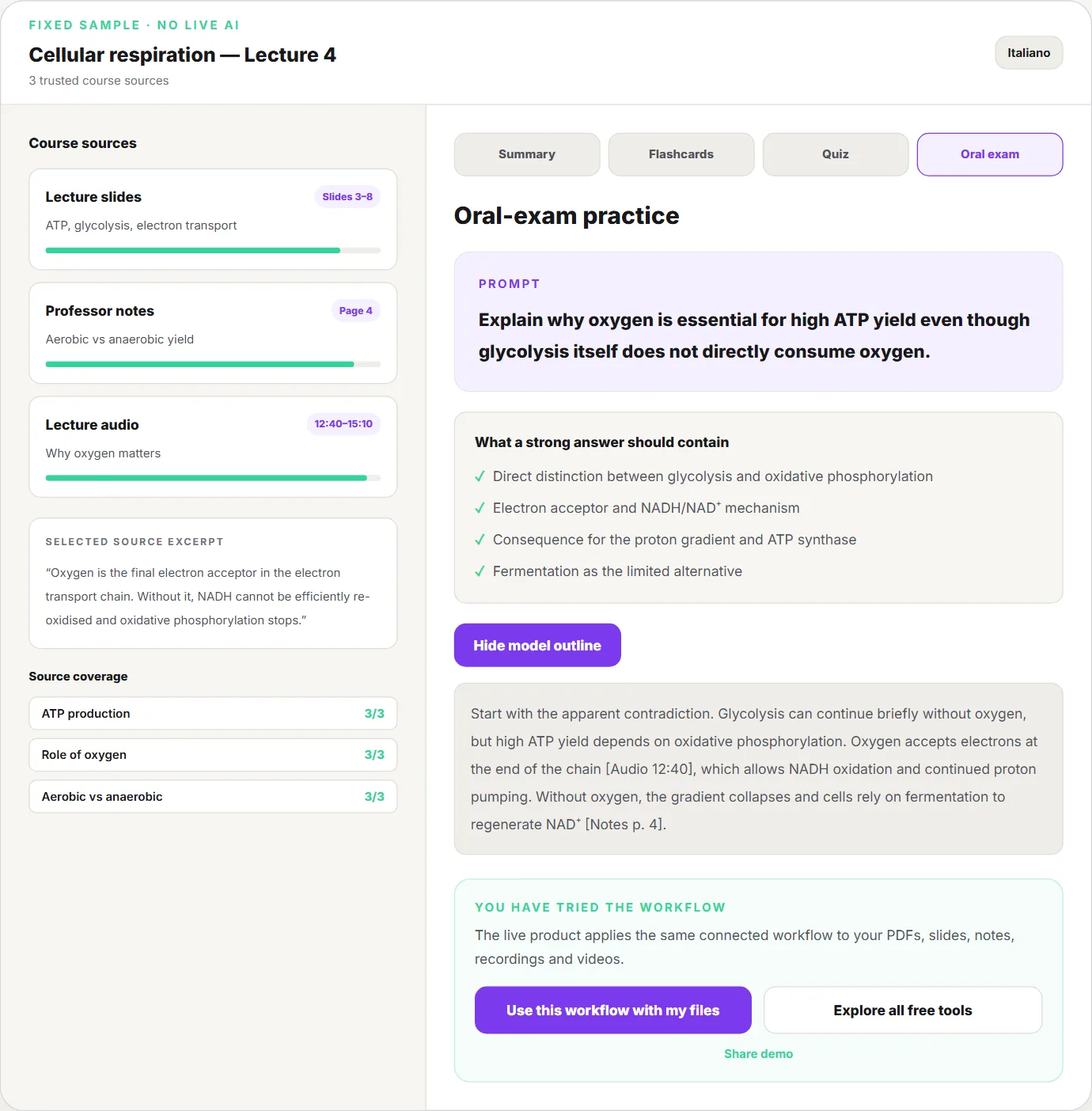
The same idea works when a tool gives the prompt: the screenshot shows an oral question with a short list of what a strong answer should contain, and a model outline that stays hidden until you have answered. You can try it in the oral tab of the sample notebook.
Example: turning a weak answer into a good retry
Example Question: "How should a 95% confidence interval be interpreted?" The first answer gives the formula, then says there is a 95% probability that the true value lies in this particular interval. That is the classic error. Scored: directness 1, structure 1, accuracy 0, transfer 0.
Repair: in the frequentist framework, the 95% refers to the procedure. If you repeated the sampling many times, about 95% of the intervals built this way would contain the true value; a single computed interval either contains it or not. The retry question is parallel, not identical: "What would happen to the interval if the sample size quadrupled?" The new answer uses the structure: direct answer (it gets about half as wide), roadmap (standard error, formula, interpretation), one example, stop.
Step 6: run full mocks, with a person or a simulator
At least once a week in the final stretch, do a full-length mock: random questions, a timer, someone who interrupts. A study partner is ideal because they ask things you did not expect. When nobody is available, an AI examiner can ask questions from your own notes and push with follow-ups; bound it to your material and verify its corrections against the source.
Oral exam follow-up questions: what examiners ask after your first answer
A follow-up question is the examiner's second move: after your first answer, they ask why, ask for a case or push on an exception, to see whether you understand the topic or only remember it. The first answer shows what you studied; the follow-ups show how far your understanding goes. That is why step 4 ends with "stop": a short, clean answer invites a follow-up you can handle.
Most follow-ups are the next rung of the five question levels from step 3, asked in reaction to what you just said. These are the six types that come up again and again:
| Follow-up type | Typical wording | What the examiner is checking | Step 3 level |
|---|---|---|---|
| Clarify | "What exactly do you mean by ...?"; "Can you define that term?" | That you can define the words you used | Define |
| Mechanism ("why") | "Why does that happen?"; "How does X lead to Y?" | That you know the cause, not only the fact | Explain |
| Apply to a case | "What happens if ...?"; "Take this patient, client or country: ..." | That you can use the idea on facts you have not seen | Apply |
| Compare and contrast | "How is that different from ...?"; "Which would you choose, and why?" | That you can place the concept among similar ones | Relate |
| Limits and exceptions | "Is that always true?"; "When does it not work?" | That you know where the rule stops | Defend |
| Connect to another topic | "How does this link to what we did on ...?"; "Where else have you seen this?" | That the course is one system in your head, not separate chapters | Across topics |
One habit predicts follow-ups better than any list: examiners follow up on the words you used. Every technical term, name or number in your first answer is an invitation. Say "Frank-Starling mechanism" and expect "explain it". So do not name what you cannot explain, and when you listen back to a recording, underline each term you said: those are your most likely follow-ups.
A follow-up is not automatically a sign that your answer was wrong. Examiners often dig after a good answer to find where your understanding ends. If they repeat or rephrase the same question, though, they may be telling you that you missed it: answer that question directly, in one sentence, before anything else.
Worked examples: three follow-up chains
Example Each chain shows a first question, a short first answer, two follow-ups and replies that hold up. The subjects differ on purpose: the pattern is the same.
Physiology: cardiac output
- Examiner: "What is cardiac output?"
- First answer: "The volume of blood each ventricle pumps per minute: heart rate times stroke volume, around 5 litres a minute in a resting adult."
- Follow-up (mechanism): "Why does stroke volume rise when more blood returns to the heart?"
- Strong reply: "Because of the Frank-Starling mechanism. More filling stretches the ventricular muscle fibres, which brings actin and myosin closer to their best overlap and makes the fibres more sensitive to calcium, so the next contraction is stronger. Within limits, the heart pumps out what comes in."
- Follow-up (apply to a case): "So what goes wrong in heart failure?"
- Strong reply: "The curve flattens. Extra filling raises the pressure inside the ventricle but adds little stroke volume, so pressure backs up into the veins behind it: into the lungs when the left side fails, which is why breathlessness is a typical symptom."
Why it holds up: the first answer names only one formula, so the follow-up lands on ground the student prepared. The "why" reply gives a cause, and the case reply goes from the mechanism to a symptom.
Economics: price ceilings
- Examiner: "What is a binding price ceiling?"
- First answer: "A legal maximum price set below the market equilibrium. At that price quantity demanded exceeds quantity supplied, so there is a shortage."
- Follow-up (apply to a case): "Take rent control in a big city. Is the shortage the same after one year and after ten?"
- Strong reply: "No, it tends to grow. In the short run the housing stock is fixed, so supply is inelastic. Over ten years supply becomes more elastic: fewer new rental units are built, some flats are sold or converted, maintenance is cut. Because the price cannot ration the flats, waiting lists and other non-price rationing do it instead."
- Follow-up (limits and exceptions): "Is there a case where a price ceiling does not reduce the quantity sold?"
- Strong reply: "Yes. A ceiling set above equilibrium is not binding and changes nothing. And in a monopoly, a ceiling set between the competitive price and the monopoly price can raise output, because the firm no longer gains from restricting quantity to keep the price up."
Why it holds up: the student expected the "long run" and "exception" rungs, which are what separate a textbook definition from an economist's answer.
History: causes of the French Revolution
- Examiner: "What were the main causes of the French Revolution?"
- First answer: "Three causes worked together: a fiscal crisis of the monarchy, a tax system that largely exempted the clergy and nobility, and the bad harvest of 1788, which pushed bread prices up. Calling the Estates-General in 1789 turned the crisis into a political confrontation."
- Follow-up (clarify): "You said fiscal crisis. Why couldn't the king simply raise taxes?"
- Strong reply: "Because new taxes ran into the privileged orders and the parlements. In 1787 Calonne proposed a land tax on all landowners to the Assembly of Notables, which rejected it, and the Parlement of Paris then argued that only the Estates-General could consent to new taxes. The money problem became a question of who had the right to approve taxation."
- Follow-up (connect to another topic): "How does that link to France's role in the American War of Independence?"
- Strong reply: "France paid for its intervention largely by borrowing, which added to the debt and to the interest the crown had to pay every year. The war also gave French officers and readers a recent example of a revolt against taxes imposed without consent."
Why it holds up: "fiscal crisis" was the term most likely to be tested, and the student had the concrete events behind it ready, with dates and names.
How to practise follow-up questions
Follow-ups are hard to rehearse from notes, because the next question depends on what you just said. You need someone, or something, that listens and reacts:
- A friend with six cards. Write the six types on cards: "What do you mean by ...?", "Why?", "What if ...?", "Compared with what?", "Always?", "How does this connect to ...?". Your friend does not need to know the subject: after your 60-90 second answer, they pick a card and fill it with a word you used. Keep going until you get stuck; the question that stopped you goes into your list for the next loop.
- Chains of three. In the 20-minute loop, replace the two fixed follow-ups with a chain: three follow-ups in a row, each built on your last reply. The point where the chain breaks is exactly where your understanding ends, and that is what you fix in minutes 11-14.
- An AI examiner that only asks follow-ups. Give a chatbot your notes and an instruction like: "Ask me one question from these notes. After my answer, ask only follow-up questions based on what I just said, one at a time. When I say something wrong or vague, stop and quote the part of the notes that corrects me." Memoniq's AI oral exam simulator runs this by voice on your own slides or notes. Either way, the AI can make mistakes: check every correction against your notes.
Why the "why" questions are worth the effort: explaining why a fact is true (elaborative interrogation) and explaining your own reasoning (self-explanation) were both rated as techniques of moderate utility in the review by Dunlosky et al. (2013), with practice testing and distributed practice rated high. A follow-up drill is practice testing with the "why" built in.
Not sure whether follow-ups or the basics are your weak spot? The two-minute exam readiness check points to the weakest part of your preparation before you add more drills.
What to do when you do not know the answer
- Take two seconds. A short pause reads as thinking. Long silence reads as a blank.
- Restate or ask. "Do you mean in the short term or the long term?" is a legitimate clarification, not a stall.
- Start from what you know. Put the question in a wider context or answer a closely related point. Examiners often steer you back from there.
- Be honest about the gap. "I don't remember the exact value, but it goes up because..." beats a confident wrong number.
- Do not suspect a trick. Most questions mean exactly what they say; overthinking wastes your time.
Practise this on purpose: in some loops, ask for a question slightly beyond what you studied and rehearse the recovery.
Phrase bank for oral exams
Having a few sentences ready for each moment of an answer frees your working memory for the content. Adapt the wording to your language and field, and say them aloud in practice until they feel like yours.
| Moment | Phrases you can use |
|---|---|
| Opening with the direct answer | "In short, ..."; "The main reason is ..."; "X is ..., and the key point is ..." |
| Giving the roadmap | "I'll cover three things: ..., ... and ..."; "Let me start with the mechanism, then the consequences." |
| Adding the example | "A concrete case is ..."; "For example, in [case or experiment] ..." |
| Linking and stopping | "So, to answer your question: ..."; "That's the core of it. I can go into [detail] if useful." |
| Buying a few seconds | "Let me think about that for a moment."; "That's a good question; there are two ways to look at it." |
| Clarifying the question | "Do you mean in the short term or the long term?"; "Are you asking about the mechanism or the evidence?" |
| Admitting a gap honestly | "I don't remember the exact figure, but I know it increases because ..."; "I'm not sure about that detail; what I can say is ..." |
| Correcting yourself | "Sorry, let me correct that: ..."; "I said X, I meant Y." |
Self-correction deserves practice too. A quick, calm correction usually costs far less than letting a wrong statement stand, and examiners hear it as understanding.
On the day
- Arrive early and check whether you can listen to earlier candidates: you learn the examiner's style.
- Take one slow breath before your first answer and keep the first sentence short.
- Listen to the whole question; answer that one, not the one you prepared.
- Watch the examiner: if they nod and move on, stop elaborating.
- Afterwards, write down the questions you got while they are fresh. They are gold for the next exam.
If nerves are the main problem
Most oral-exam nerves come from not knowing what it will feel like. Exposure helps more than reassurance: record yourself, answer in front of a friend, do the mock at the same time of day as the exam. On the day, slow the first answer down deliberately. If anxiety is severe or affects everything you do, talk to your university's student support service; many offer help for exam anxiety.
Limits
No method guarantees a grade. Speech recognition can mishear technical terms, names and formulas, and a simulator does not know your examiner's preferences unless they appear in your sources. For medicine, law and other high-stakes fields, verify any correction against current authoritative material.
Sources
- Roediger & Karpicke (2006), Test-enhanced learning
- Dunlosky et al. (2013), Improving students' learning with effective learning techniques
- Chi et al. (1989), Self-explanations
- Hattie & Timperley (2007), The power of feedback
- Hamilton College Oral Communication Center, How to take an oral exam
- Martin Steffen, How to prepare for an oral exam (compiler construction course page)
Frequently asked questions
How far in advance should I prepare for an oral exam?
Three to four weeks is comfortable for a university oral: two weeks to cover the material and build a question list, then about two weeks of daily speaking practice.
How do I practise for an oral exam alone?
Answer a question aloud for up to two minutes without notes, record it, answer two follow-ups, score it on directness, structure, accuracy and transfer, fix the weak step and retry a parallel question.
How should I structure an answer in an oral exam?
Give a one-sentence direct answer, announce two or three points, explain them with one concrete example, then link back to the question and stop so the examiner can follow up.
What should I do if I don't know the answer?
Pause briefly, ask a clarifying question if it is ambiguous, start from what you do know and be honest about the gap. A partial, correct answer beats a confident wrong one.
How long should an oral exam answer be?
Usually one to two minutes before the first follow-up. Longer answers risk losing the examiner and leave less time for the questions where you gain marks.
How can I calm my nerves before an oral exam?
Rehearse the real conditions: answer in front of someone, record yourself and practise at the time of day of the exam. On the day, slow down your first answer deliberately.
What phrases can I use in an oral exam?
Prepare one or two for each moment: a direct opening ('In short, ...'), a roadmap ('I'll cover three things'), a way to buy a few seconds ('Let me think about that for a moment'), a clarification ('Do you mean the mechanism or the evidence?') and an honest gap ('I don't remember the exact figure, but I know it increases because ...').
Can AI help me practise for an oral exam?
Yes, as a practice partner: an AI examiner can ask questions from your own notes and push with follow-ups. Keep it bound to your sources and check its corrections against the original.
What are typical oral exam follow-up questions?
Six types come up most: clarify ('What exactly do you mean by ...?'), mechanism ('Why does that happen?'), apply to a case ('What happens if ...?'), compare ('How is that different from ...?'), limits ('Is that always true?') and connect ('How does this link to ...?'). Examiners usually build them on the words you used in your first answer.
Does a follow-up question mean my answer was wrong?
Not necessarily. Examiners often follow up a good answer to see how deep your understanding goes. If they repeat or rephrase the same question, they may be signalling that you missed the point: answer it directly in one sentence first.
Keep reading
How to Prepare for a Medical Viva Exam: Structures, Questions and a 4-Week Plan
An answer ladder you can say out loud, 16 classic viva questions with outline answers, a four-week plan, a five-criterion rubric and a safe way to practise with an AI examiner.
How to Study for In-House Exams in Medical School
In-house exams are written from your lectures. A per-lecture workflow, an AnKing decision tree, a sample lecture-day schedule and how pass/fail changes the balance.
How to Make Anki Cards From Lecture Slides with AI (Without a Bloated Deck)
AI drafts, you prune: a worked example on one slide, a neutral guide to tool types, CSV vs .apkg, image occlusion, cards per lecture and how to combine with AnKing.
Roberto Coscia
Nursing graduate (BSc) · Founder of Memoniq
Sources are cited and checked at the end of the article. Medical content is educational: always verify against your course material. About the author · Editorial policy
Last updated: September 27, 2026