
Spaced Repetition Schedule for Exams: Intervals, Examples and a Calendar
Spaced repetition schedules for exams 7, 14, 30 and 60+ days away, a worked week, what the research says about gaps, and a free calendar calculator.
Contents (15 sections)
A good spaced repetition schedule reviews each topic at growing gaps, for example 1, 3, 7, 14 and 30 days after you first learn it, and shortens the gap whenever you fail to recall. The exact numbers matter less than two rules: every review is an attempt to recall before you look, and the last gap should end close to the exam. Below you will find ready-made schedules for exams 7, 14, 30 and 60+ days away, a worked week, and what the research actually says.
In short
- Start with expanding gaps (1-3-7-14-30 is a fine default), then adapt to your results.
- The best gap depends on how far away the exam is: about 20-40% of the time to the test for a one-week horizon, 5-10% for a one-year horizon (Cepeda et al., 2008).
- A review means answering from memory first, then checking. Rereading is not a review.
- Plan by capacity: new topics plus due reviews must fit into the minutes you really have.
- Flashcard apps such as Anki automate the gaps per card; you still need a plan for the topics.
Want the dates without the maths? The free spaced repetition schedule calculator takes your exam date, number of topics, study days and daily minutes, and exports a calendar. No account needed.
Spaced repetition schedules by exam date
Day 1 is the day you first study a topic properly. Each number is the day of a review, counted from that day. These are starting points, not laws.
| Exam is in... | Reviews on day | Number of reviews | Note |
|---|---|---|---|
| 7 days | 2, 4, 6 | 3 | Short gaps; the last review the day before the exam |
| 14 days | 2, 4, 8, 13 | 4 | Keep one mixed session on day 12-13 |
| 30 days | 2, 5, 12, 21, 28 | 5 | Close to the classic 1-3-7-14 pattern |
| 60+ days | 2, 7, 17, 35, then every 3-4 weeks | 5+ | Longer gaps, plus a final check in exam week |
Every row follows the same logic: the first review comes quickly, because that is when most forgetting happens, and each later gap is longer. If you fail a review, restart that topic from a short gap instead of keeping to the plan.
What the research supports, and what it does not
The spacing effect is one of the most replicated findings in learning research. Cepeda and colleagues (2006) analysed 839 assessments from 317 experiments and found that spreading study sessions out beats massing them, and that the best gap grows as the retention interval grows.
Their 2008 study with more than 1,350 people made this concrete. As a share of the time until the test, the optimal gap fell from about 20-40% for a test one week away to about 5-10% for a test one year away. For an exam in 30 days, that suggests a first gap of a few days, not a few hours and not three weeks. It also means there is no universal "1-3-7" schedule that is best for everyone.
Spacing works best when each session is a retrieval attempt. In Roediger and Karpicke (2006), students who restudied did better on a test five minutes later, but students who had tested themselves did better two days and one week later, even though the restudy group felt more confident. Dunlosky et al. (2013) rated practice testing and distributed practice as the only two "high utility" techniques out of ten.
For medical students specifically, a 2026 meta-analysis of 13 studies and 21,415 learners (Maye & Hurley) found a clear advantage for spaced repetition over standard studying on objective tests, with flashcards, emailed questions and spaced quizzes all counted.
Work out your own first gap
The two anchor points from Cepeda et al. (2008) are enough to size your first gaps with a calculator on your phone. Multiply the days left until the exam by the share, and round to whole days:
| Days until the test | Optimal share reported | Gap in days | What that means in practice |
|---|---|---|---|
| 7 | about 20-40% | 7 × 0.2-0.4 = 1.4-2.8 | First review on day 2 or 3, as in the 7-day row of the schedule table |
| 365 | about 5-10% | 365 × 0.05-0.10 = 18-37 | A gap of roughly three to five weeks between sessions |
| 30 or 60 | between the two | a few days, growing | The share shrinks as the horizon grows, so a month-long plan starts with gaps of a few days, not hours and not weeks |
One caveat keeps this honest. The 2008 study measured a single gap between two study sessions followed by a test; it did not test a chain of five reviews. Use the numbers to size the first gaps, then let your recall results set the later ones, as described in adjusting the gap to your results.
The forgetting curve, read correctly
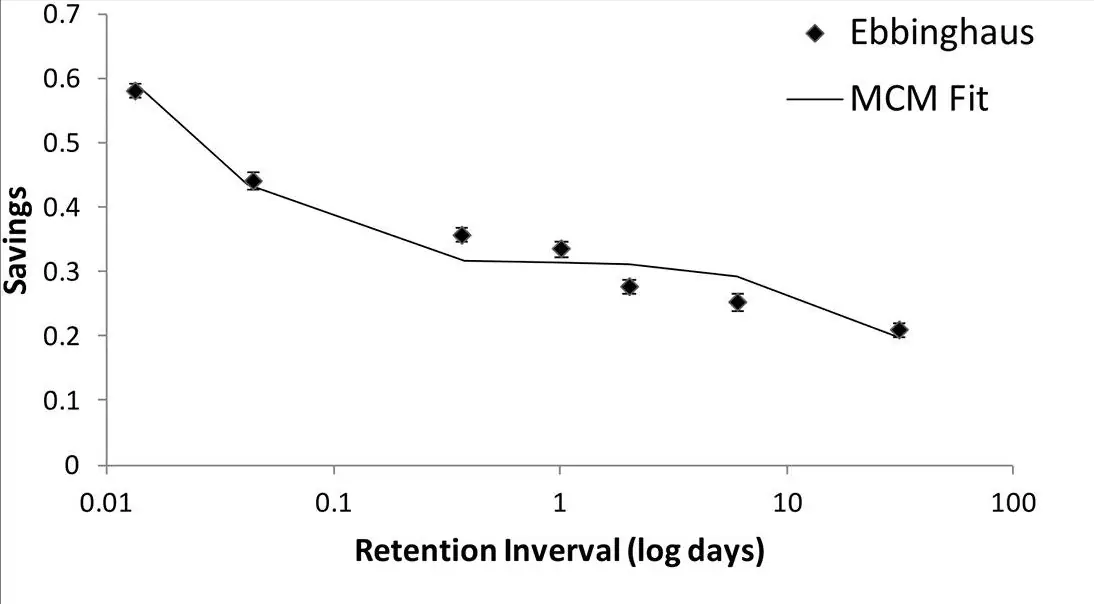

Spaced repetition guides love the claim that "you forget 70% within 24 hours". That number does not come from Ebbinghaus the way it is usually quoted. He tested himself on nonsense syllables and measured savings: how much less time it took to relearn a list. After one day his savings were about a third, and a 2015 replication by Murre and Dros found a similar curve. That is not the same as forgetting 70% of a lecture you understood. Meaningful material fades more slowly than nonsense syllables. The part that does transfer is the shape: a steep early drop, then a slow tail. That is why the first review comes fast.
A worked week: 12 topics, 30 days, one hour a day
Example Say you have 12 topics, study Monday to Saturday, one hour a day. A first proper study of a topic takes about 30 minutes; a review (answer from memory, check, correct) about 10. Using reviews at +1 and +4 days in the first week, the plan looks like this:
| Day | New topics | Reviews due | Minutes |
|---|---|---|---|
| Mon (day 1) | T1, T2 | - | 60 |
| Tue (day 2) | T3 | T1, T2 | 50 |
| Wed (day 3) | T4 | T3 | 40 |
| Thu (day 4) | T5 | T4 | 40 |
| Fri (day 5) | T6 | T1, T2, T5 | 60 |
| Sat (day 6) | T7 | T3, T6 | 50 |
| Sun (day 7) | Rest. T4's +4 review slides to Monday. | 0 | |
Two things show up quickly. First, you can only add about one new topic a day once reviews start, so all 12 topics are introduced by the end of week 2 (if the reviews still fit), leaving room for the longer gaps before day 30. Second, Friday is already full. By week 3 reviews pile up and you will need to either add time or drop to fewer new topics. Seeing that on day 1 is the point of planning; the exam study plan calculator checks whether the whole syllabus fits before you start.
The same worked week in the calculator
To check the hand-made plan, I entered the same numbers into the calculator with the same inputs: 12 topics, exam in 30 days, 60 minutes a day, 30 minutes for a first study pass, 10 minutes per review, Monday to Saturday. It was run on 25 September 2026, so the calendar starts on a Friday.
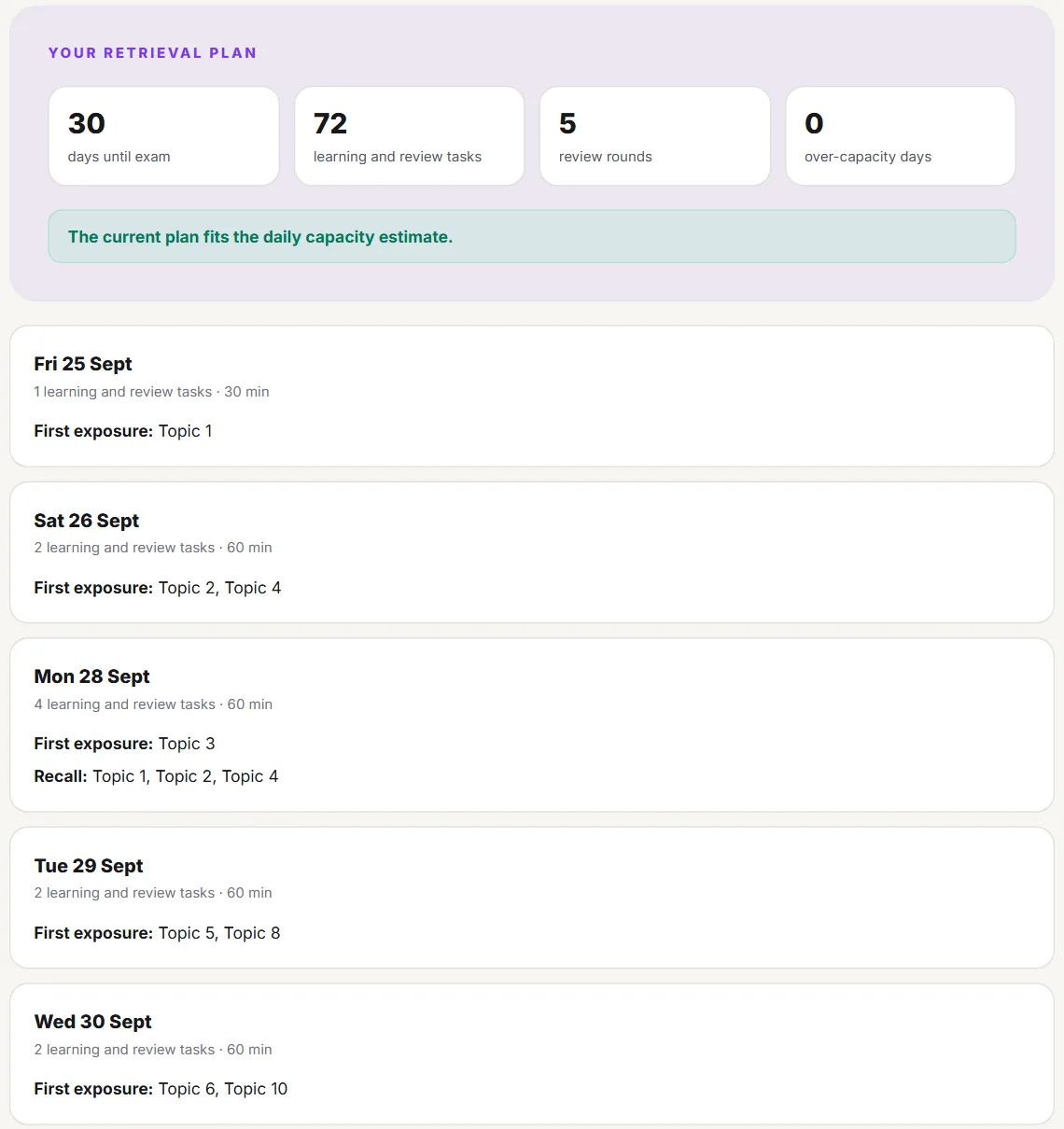
| Hand-made plan above | Calculator output | |
|---|---|---|
| New topics per study day | 1-2 | 1-2 |
| First recall of topic 1 | The next day (+1) | Three calendar days later (Fri to Mon, Sunday off) |
| All 12 topics introduced by | End of week 2, if reviews still fit | The 8th study day |
| Capacity check | Friday already full by hand | "0 over-capacity days" across 72 learning and review tasks and 5 review rounds |
Neither plan is "the" right one. The hand-made week puts an extra early review on every topic, which suits hard material; the calculator gets the whole syllabus started sooner and keeps every day inside your minutes, which suits a broad exam. A reasonable mix is to accept the calculator's dates and add a same-week retrieval by hand for the two or three topics you found hardest.
What to do in each review session
- Close the source. Read the question or topic title only.
- Retrieve in the exam format. Say it aloud for an oral, write the derivation for a calculation exam, apply the rule to a case.
- Check against the source. Compare with the slide, page or worked example.
- Repair one failure. Write the missing step or correction, not a new full summary.
- Set the next gap from the result. Use the rule in the table below.
Adjust the gap to your results
| What happened | Next step |
|---|---|
| Wrong or blank | Check the source, repair, and review again in 1 day |
| Right only after a big hint | Keep a short gap and test with different wording |
| Right but slow or incomplete | Keep the planned gap, add one application question |
| Right, fast and you can explain why | Move to the next, longer gap |
Paper cards: the Leitner system
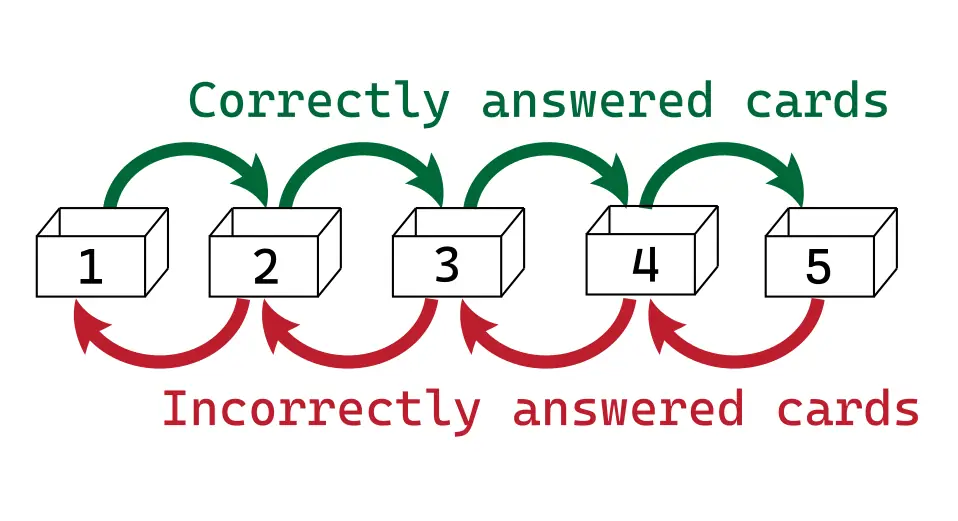

If you prefer paper, the Leitner system does the scheduling for you. One common setup uses five boxes: box 1 every day, box 2 every two or three days, box 3 once a week, box 4 every two weeks, box 5 before the exam. A correct answer moves the card forward one box; a wrong answer sends it back. It is crude, but it applies the same principle as the apps.
Anki and other apps: what they automate
Anki and similar apps calculate a separate gap for every card from your answers. Since version 23.10, Anki includes the FSRS scheduler as an alternative to its older SM-2-based algorithm. With FSRS you set a "desired retention"; the Anki manual says the default of 90% "will schedule cards so you have a 90% chance of remembering them" when they come up. Higher retention means more reviews per day.
What apps do not do is plan your topics. They do not know your exam date, how many hours you have, or that a whole lecture has no cards yet. Use a topic calendar like the one above for coverage, and the app for card-level timing. If your cards come from lecture slides, see how to make Anki cards from lecture slides.
What if the exam is in 3 days?
You can still space, just on a smaller scale. Study each topic, then retrieve it again later the same day, the next day and on the last day, mixing topics in each session. At this point scope matters more than timing: decide which topics are most likely to be examined and practise those in the exam format. A long-term schedule copied into three days is just cramming with extra steps.
Five mistakes that break the schedule
- Using rereading as every "review".
- Starting topics so late that no long gap fits before the exam.
- Giving every topic the same time regardless of difficulty and weight.
- Ignoring daily capacity until the calendar collapses in week 3.
- Only reviewing definitions when the exam asks for comparison, application or explanation.
Mixing topics within a session (interleaving) can help when the exam requires you to tell problem types apart, but the benefit depends on the material. Mix related topics on purpose, not at random.
From dates to study material
The calculator handles timing. Memoniq provides the retrieval material: one set of course files becomes a source-grounded summary, flashcards, quizzes, lessons and oral practice, and mastery signals show which topics need an earlier review. The loop is plan, retrieve, check, repair, reschedule. For turning a folder of files into topics you can schedule, see how to build an AI study guide from your course files.
Limits
A generic schedule cannot know item difficulty, prior knowledge, sleep, stress or the quality of your sources, and it does not predict a grade. Clinical, legal and safety-critical content must be checked against current authoritative material.
Once the dates are set, the reviews need material to retrieve. If your course lives in PDFs, turn a PDF into recall questions first, then slot those cards into the calendar.
Sources and further reading
- Cepeda et al. (2006), Distributed practice in verbal recall tasks: a review and quantitative synthesis
- Cepeda et al. (2008), Spacing effects in learning: a temporal ridgeline of optimal retention
- Roediger & Karpicke (2006), Test-enhanced learning
- Dunlosky et al. (2013), Improving students' learning with effective learning techniques
- Murre & Dros (2015), Replication and analysis of Ebbinghaus' forgetting curve
- Maye & Hurley (2026), Spaced repetition in medical education: systematic review and meta-analysis
- Roediger & Butler (2011), The critical role of retrieval practice in long-term retention
- Brunmair & Richter (2019), Interleaved learning meta-analysis
- Anki manual: deck options and FSRS
Frequently asked questions
What is the best spaced repetition schedule for an exam?
There is no single best interval. Start with expanding gaps such as 1, 3, 7, 14 and 30 days, fit the last review close to the exam, and shorten the next gap whenever you fail to recall.
Is the 1-3-7-14-30 rule scientifically exact?
No. It is a practical heuristic. Cepeda et al. (2008) found that the optimal gap depends on how far away the test is, from about 20-40% of a one-week horizon to 5-10% of a one-year horizon.
How many times should I review a topic before the exam?
Three reviews is a realistic minimum for an exam a week away and four to five for one a month away, plus extra reviews for anything you get wrong.
Can I use spaced repetition if my exam is in a few days?
Yes, on a smaller scale: study a topic, retrieve it again later the same day, the next day and the last day. With so little time, choosing the most likely topics matters more than the exact gaps.
Is rereading my notes a spaced review?
Not really. Answer, explain or solve from memory first, then check the source and correct. Rereading gives a feeling of fluency without testing recall.
What is the difference between spaced repetition and active recall?
Active recall is how you review (retrieving from memory); spaced repetition is when you review (at growing gaps). They work best together.
Does Anki use a fixed schedule?
No. Anki calculates a gap per card from your answers, with an SM-2-based algorithm or, since version 23.10, FSRS with a desired retention that defaults to 90%.
How do I work out my first review gap?
Multiply the days left until the exam by the optimal share reported by Cepeda et al. (2008): about 20-40% for a test a week away (a first gap of 1-3 days) and about 5-10% for a test a year away (roughly 18-37 days). Then let your recall results set the later gaps.
Does spaced repetition work for medical school?
A 2026 meta-analysis of 13 studies and 21,415 learners in medical education found a clear advantage for spaced repetition over standard studying on objective tests.
Keep reading
How to Study for In-House Exams in Medical School
In-house exams are written from your lectures. A per-lecture workflow, an AnKing decision tree, a sample lecture-day schedule and how pass/fail changes the balance.
How to Make Anki Cards From Lecture Slides with AI (Without a Bloated Deck)
AI drafts, you prune: a worked example on one slide, a neutral guide to tool types, CSV vs .apkg, image occlusion, cards per lecture and how to combine with AnKing.
How to Prepare for a Medical Viva Exam: Structures, Questions and a 4-Week Plan
An answer ladder you can say out loud, 16 classic viva questions with outline answers, a four-week plan, a five-criterion rubric and a safe way to practise with an AI examiner.
Roberto Coscia
Nursing graduate (BSc) · Founder of Memoniq
Sources are cited and checked at the end of the article. Medical content is educational: always verify against your course material. About the author · Editorial policy
Last updated: September 25, 2026